If you have ever wondered whether “flys” or “flies” is the correct spelling, you are not alone. At first glance, flys may seem logical because many English plurals simply add -s. However, standard English uses flies, not flys, in everyday writing.
Flies can be the plural of fly when talking about insects, or it can be the third-person singular present form of the verb fly. For example, we say, “There are three flies in the room” and “The bird flies over the trees.”
The good news is that the rule is easy to remember. Once you understand why fly changes to flies, you can avoid this common spelling mistake in schoolwork, emails, articles, and everyday writing.
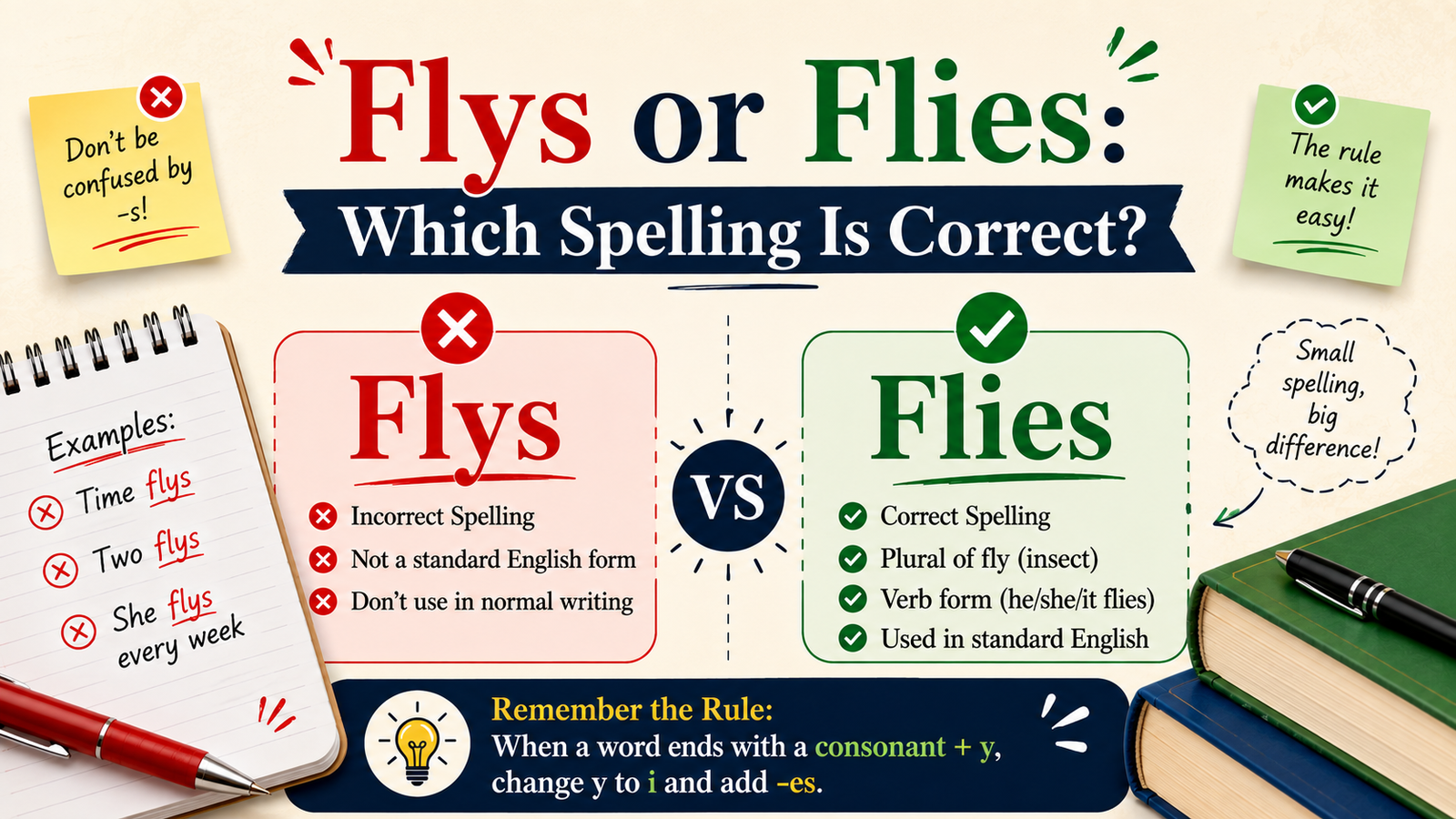
Flys or Flies: Which Spelling Is Correct?
The correct spelling in standard English is flies.
Flys is generally considered a spelling mistake when you mean the plural of fly or the verb form used with he, she, or it. Major dictionaries list flies as the plural noun form and as the present-tense form of fly.
Why “Flies” Is Correct
The word fly ends with a consonant + y: the letter l comes immediately before y.
When many English words ending in a consonant + y become plural, the y changes to i and -es is added.
For example:
- fly → flies
- baby → babies
- city → cities
- lady → ladies
- party → parties
This is why flies, rather than flys, is the standard spelling.
Is “Flys” Ever Correct?
For normal English writing, you should use flies.
The spelling flys may occasionally appear as part of a proper name, brand name, username, title, or quoted material. In those cases, the unusual spelling may be intentional and should be preserved.
However, if you are writing a normal sentence and need the plural of fly or the verb form of fly, choose flies.
What Does “Flies” Mean?
The word flies has two especially common grammatical uses: it can function as a plural noun or as a verb.
“Flies” as a Plural Noun
As a noun, flies means more than one fly—the small flying insect.
Examples:
- One fly is sitting on the window.
- Two flies are near the food.
- The flies keep bothering us.
- Several flies entered through the open door.
- Fruit flies can become a nuisance in the kitchen.
Oxford lists flies as the plural of fly, while Merriam-Webster also gives flies as the plural form of the noun referring to a winged insect.
“Flies” as a Verb
Flies is also the present-tense form of the verb fly when the subject is he, she, it, or another singular third-person subject.
Compare:
- I fly to London.
- You fly to London.
- We fly to London.
- They fly to London.
- She flies to London.
- He flies every Friday.
- The plane flies over the city.
Oxford specifically lists the present forms as I/you/we/they fly and he/she/it flies.
A Simple Way to Tell the Difference
Look at what comes before flies.
If it refers to more than one insect, it is a noun:
The flies are buzzing around the kitchen.
If it describes what a singular subject does, it is a verb:
The eagle flies above the mountains.
Either way, flies is the correct spelling.
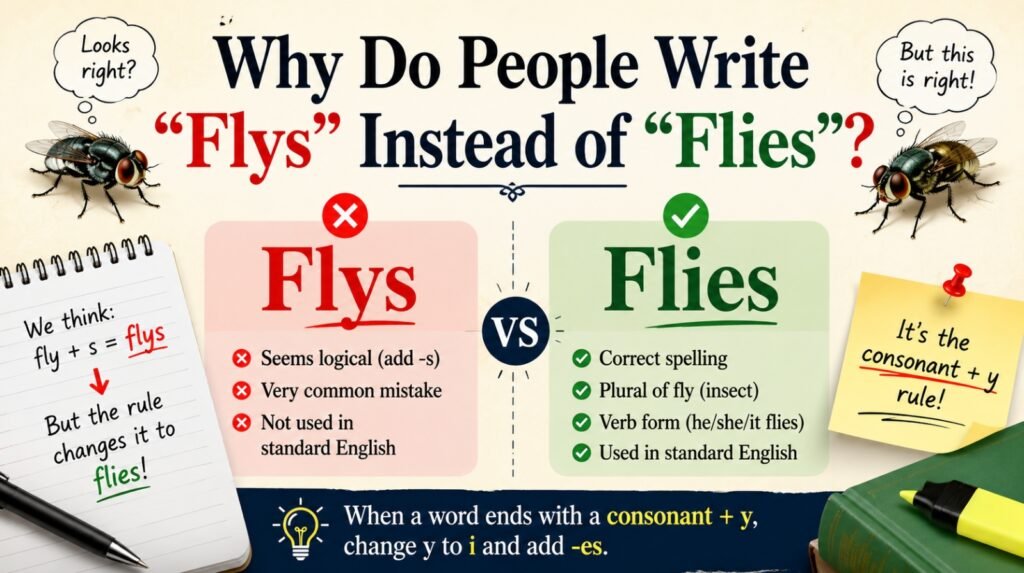
Why Do People Write “Flys” Instead of “Flies”?
The mistake usually happens because English has a very common plural pattern: simply add -s.
For example:
- book → books
- car → cars
- tree → trees
- phone → phones
So it is understandable that someone might think:
fly + s = flys
However, fly follows a different spelling pattern because the y is preceded by a consonant.
The Consonant + Y Rule
When a common noun ends in a consonant followed by y, the usual plural pattern is:
consonant + y → i + es
Examples:
| Singular | Plural |
|---|---|
| fly | flies |
| city | cities |
| baby | babies |
| story | stories |
| country | countries |
| party | parties |
Grammarly’s current plural-noun guidance gives the same general rule: when a noun ends in a consonant followed by y, the y changes to i before -es is added.
Be Careful With Vowel + Y Words
The rule becomes easier when you compare fly with a word ending in a vowel + y.
For example:
- boy → boys
- toy → toys
- day → days
- key → keys
Here, the letter before y is a vowel, so the y stays.
Therefore:
fly → flies
but:
boy → boys
That small difference explains why flys looks tempting but is incorrect.
Flies vs. Fly: Examples You Can Copy
Understanding when to use fly, flies, and other forms of the verb can make the spelling rule much easier.
“Fly” for I, You, We, and They
Use fly with I, you, we, and they in the simple present.
Examples:
- I fly home tomorrow.
- You fly frequently for work.
- We fly to New York every summer.
- They fly across the country.
See Also: Tomorrow vs Tommorow: Which Spelling Is Correct?
“Flies” for He, She, It, and Singular Subjects
Use flies with a singular third-person subject.
Examples:
- He flies to Chicago every month.
- She flies home on Sunday.
- The bird flies across the lake.
- The airplane flies above the clouds.
- A butterfly flies from flower to flower.
Oxford and Cambridge both document flies as the present-tense form used with a singular third-person subject.
“Flew” and “Flown” Are Different
Do not confuse flies with the past forms of fly.
The basic verb pattern is:
fly → flies → flying → flew → flown
Examples:
- Present: The bird flies south.
- -ing form: The bird is flying south.
- Past: The bird flew south.
- Past participle: The bird has flown south.
Oxford identifies flew as the past tense and flown as the past participle of fly.
Common “Flys” vs. “Flies” Mistakes
These mistakes are easy to fix once you know what to look for.
Incorrect: “Time Flys”
The correct expression is:
Time flies when you’re having fun.
Here, flies is a verb. The subject time is singular, so the verb takes the third-person singular form.
Oxford also lists time flies as an established expression meaning that time seems to pass very quickly.
Incorrect: “Two Flys”
The correct sentence is:
Two flies landed on the table.
Here, flies is the plural noun because there is more than one insect.
Incorrect: “She Flys Home”
The correct version is:
She flies home every Friday.
Because she is singular, the present-tense verb is flies.
Quick Correction Checklist
| Incorrect | Correct |
|---|---|
| Two flys | Two flies |
| She flys home | She flies home |
| Time flys | Time flies |
| The flys are annoying | The flies are annoying |
| A bird flys overhead | A bird flies overhead |
2025–2026 Data & Dictionary Check
Because spelling questions are often answered using outdated grammar rules or informal examples, it is useful to check current authoritative references.
A 2025–2026 reference snapshot confirms the same standard usage:
- Merriam-Webster: lists flies as the plural of the noun fly and identifies flies as a form of the verb fly. Its current dictionary entry was updated in March 2026.
- Oxford Learner’s Dictionaries: lists flies as the plural noun form of fly and gives he/she/it flies in the present simple.
- Grammarly’s plural-noun guidance, updated January 2025: explains that nouns ending in a consonant + y generally change y to i before adding -es.
So the evidence from current dictionary and grammar references is consistent: flies is the standard spelling, while flys should not be used for ordinary plural or verb usage.
Real-Life Example: Why This Mistake Happens
Imagine a student writing an English assignment about birds. The student wants to write:
“The eagle flys high above the mountains.”
At first, flys may look reasonable. The student knows that verbs such as walk become walks and run becomes runs. It is therefore natural to assume that fly simply becomes flys.
But checking the subject reveals the problem. The subject is the eagle, which is singular. Therefore, the present-tense verb needs the third-person singular form. Because fly ends in consonant + y, the spelling changes to flies.
The corrected sentence is:
“The eagle flies high above the mountains.”
Now consider a second sentence:
“Several flys landed near the window.”
Here, flies is not a verb at all. It is a plural noun because several tells us that there is more than one insect. The correct sentence is:
“Several flies landed near the window.”
This example shows why simply memorizing “add -s” is not enough. The writer needs to identify the word’s grammatical role and apply the correct spelling pattern. Once the consonant + y rule becomes familiar, both errors become much easier to avoid.
See Also: Tomorrow vs Tommorow: Which Spelling Is Correct?
A Quick Guide to Choosing the Correct Form
When you are unsure whether to write flys or flies, use this three-step check.
Step 1: Ask What You Mean
Are you talking about:
- More than one insect?
- Something a singular person or thing does?
- The general verb fly?
If it is one of the first two, flies is probably the form you need.
Step 2: Check the Subject
For the verb:
- I fly
- You fly
- We fly
- They fly
- He flies
- She flies
- It flies
Step 3: Remember the Spelling Rule
If fly becomes plural or takes the third-person singular present form:
fly → flies
Never use flys in normal standard English writing.
Mini Quiz: Flys or Flies?
1. Which spelling is correct?
A) Flys
B) Flies
C) Flyes
D) Fliez
Answer: B) Flies
2. Fill in the blank
There are several ________ around the food.
Answer: flies
3. Pick the correct sentence
A) The bird flys over the tree.
B) The bird flies over the tree.
C) The bird flyes over the tree.
D) The bird fly over the tree.
Answer: B) The bird flies over the tree.
4. What is the plural of “fly”?
A) Flys
B) Flyes
C) Flies
D) Flyies
Answer: C) Flies
5. Fill in the blank
Time ________ when you’re having fun.
Answer: flies
6. Which sentence uses “flies” as a noun?
A) The airplane flies high.
B) She flies to London.
C) Several flies are on the window.
D) He flies every week.
Answer: C) Several flies are on the window.
7. Which sentence uses “flies” as a verb?
A) The flies are annoying.
B) I saw three flies.
C) The bird flies across the sky.
D) Several flies entered the room.
Answer: C) The bird flies across the sky.
8. Fill in the blank
She ________ home every Sunday.
Answer: flies
9. Why does “fly” become “flies”?
A) Because all words ending in Y use -ies
B) Because the Y is preceded by a consonant
C) Because “fly” is an irregular word
D) Because the word needs an extra vowel
Answer: B) Because the Y is preceded by a consonant
10. Which one is spelled incorrectly?
A) Babies
B) Cities
C) Parties
D) Flys
Answer: D) Flys
11. Fill in the blank
One fly, two ________.
Answer: flies
12. Which sentence is correct?
A) A bird flys above us.
B) A bird flies above us.
C) A bird flyes above us.
D) A bird flying above us.
Answer: B) A bird flies above us.
13. Quick grammar challenge
Choose the correct form:
“They ________ across the country every summer.”
A) flies
B) flys
C) fly
D) flyes
Answer: C) fly
14. Final one — can you get it right?
Complete the sentence:
“The butterfly ________ from flower to flower.”
A) fly
B) flys
C) flies
D) flyes
Answer: C) flies
How Did You Do?
12–14 correct: 🎯 Spelling pro! You’ve got “flies” down.
9–11 correct: 👍 Great job! You understand the main rule.
6–8 correct: 📚 Not bad! A quick review of the consonant + Y rule will help.
0–5 correct: 💡 No worries! Remember: fly → flies, not flys.
FAQs
Is “flys” or “flies” correct?
Flies is correct in standard English. Use it as the plural of fly or as the third-person singular present form of the verb fly.
Is “flys” a real word?
Flys is not the standard spelling for the normal plural or verb form of fly. It may appear in a proper name, brand, title, username, or quotation, but ordinary English uses flies.
What is the plural of “fly”?
The plural of fly is flies.
Correct:
One fly → two flies
Not:
One fly → two flys
Is it “time flies” or “time flys”?
The correct phrase is “time flies.”
For example:
Time flies when you’re having fun.
Here, flies is the third-person singular present form of the verb fly. Oxford lists time flies as a standard expression.
Why does “fly” become “flies”?
Because fly ends in a consonant + y. In the standard plural pattern, the y changes to i and -es is added.
So:
fly → flies
The same pattern appears in:
city → cities
baby → babies
party → parties
Do “flies” and “flys” sound different?
No. In ordinary pronunciation, the two spellings would not create a useful pronunciation distinction. The issue is correct spelling, not pronunciation.
Is “flies” a noun or a verb?
It can be both.
As a noun:
The flies are near the window.
As a verb:
The bird flies over the garden.
The sentence tells you which grammatical role flies has.
Conclusion
So, flys or flies: which spelling is correct?
The answer is simple: flies is the correct standard spelling.
Use flies when you mean more than one insect:
“Several flies are on the wall.”
Use flies as the third-person singular form of fly:
“The bird flies across the sky.”
And remember the spelling rule:
fly → flies
not:
fly → flys
Once you remember that words ending in a consonant + y often change y to i before -es, this common spelling mistake becomes much easier to avoid.
For more simple explanations of confusing English words, spelling mistakes, and grammar rules, keep exploring Gramvexa and improve your English one word at a time.
Keep learning with more easy grammar lessons on Gramvexa.

Hi, I’m Bilal Khalid, the author of Gramvexa, where I make English grammar simple and easy to understand. I write about grammar, spelling mistakes, confusing words, vocabulary, and common English errors. My goal is to help students, writers, and everyday learners write better and communicate with confidence.