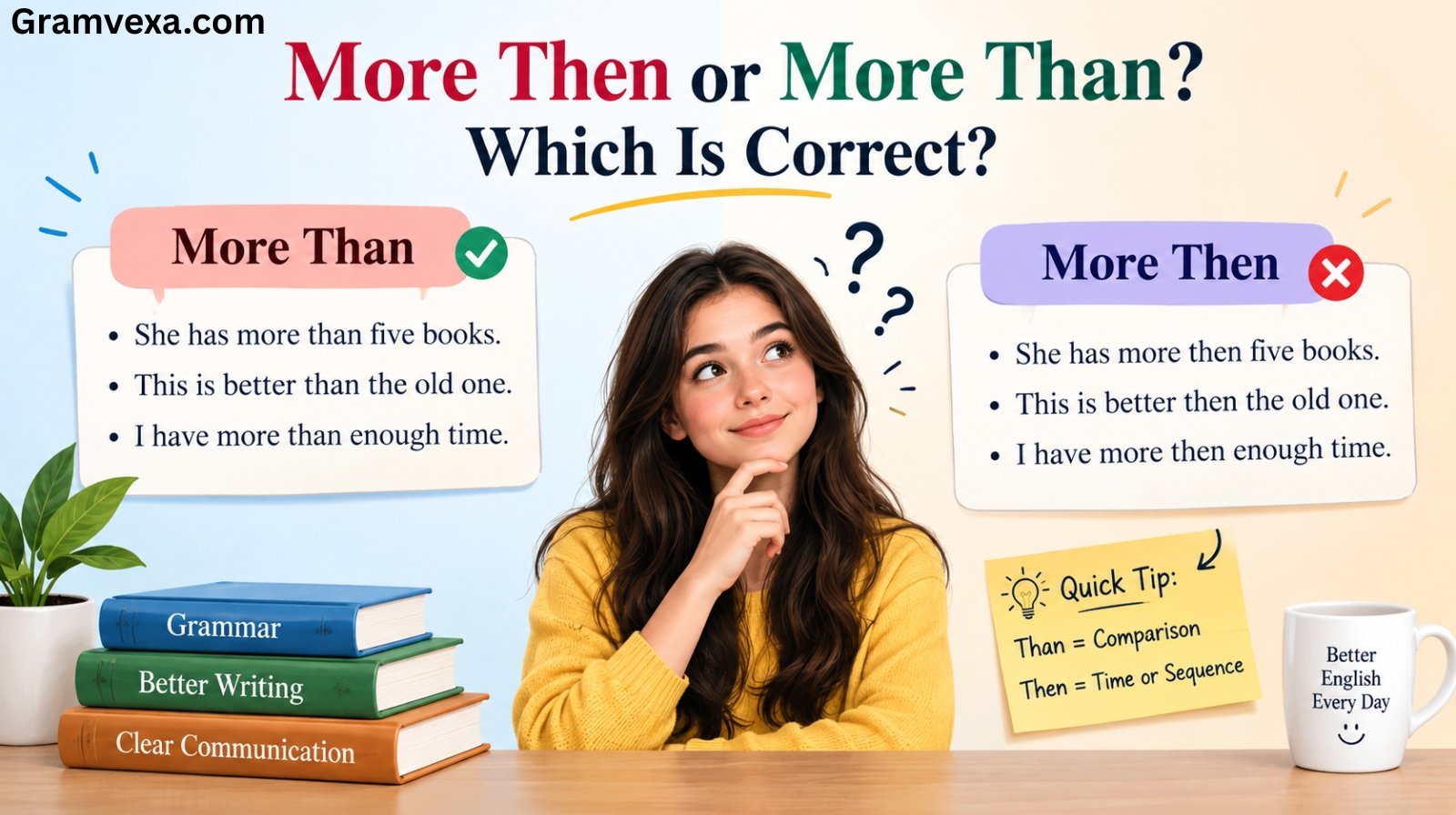
More then or more than which one is correct? If you have ever hesitated before writing this phrase, you are not alone. The correct expression is “more than,” not “more then.”
The word than is used when making a comparison or talking about an amount, number, or degree. Then, on the other hand, usually relates to time, sequence, or a result. Because the two words sound very similar in everyday speech, they are easy to mix up.
In this guide, you will learn the difference between more then and more than, see plenty of examples, and discover a simple memory trick that can help you choose the right word every time.
More Then or More Than: Which Is Correct?
The correct phrase is “more than.”
“More then” is incorrect when you are expressing a comparison or quantity.
Why “More Than” Is Correct
Than is used to compare two things or to show that an amount is greater than another amount. Cambridge Dictionary explains that than is used to connect parts of a comparison.
For example:
- She has more than ten books.
- This box weighs more than five kilograms.
- I would rather walk than drive.
- He earns more than his brother.
- The movie lasted more than two hours.
In each sentence, than introduces a comparison or indicates an amount beyond a particular point.
Why “More Then” Is Wrong
Then has a different job. It commonly refers to time or sequence.
For example:
- We ate dinner and then watched a movie.
- I lived there then.
- First finish your homework, then you can play.
- If it rains, then we will stay home.
So, when you write “more then,” you are combining more with a word that does not normally belong in that comparison.
What Does “More Than” Mean?
More than means a quantity, number, amount, or degree that is greater than something else.
It can be used with numbers, people, objects, time, money, and abstract ideas.
More Than With Numbers
When an amount is greater than a particular number, use more than.
Examples:
- There were more than 100 people at the event.
- The video received more than 10,000 views.
- She has worked there for more than five years.
- The box contains more than 20 items.
More Than With Comparisons
“More than” can also compare one thing with another.
Examples:
- I like tea more than coffee.
- She enjoys reading more than watching television.
- This method is more effective than the old one.
- He is more experienced than his colleague.
More Than Can Mean “Over”
In many contexts, more than can be replaced by over without changing the basic meaning.
For example:
The building is more than 100 years old.
You could also say:
The building is over 100 years old.
However, more than is especially useful when you want to make a comparison or emphasize an amount.
What Does “Then” Mean?
The word then is primarily associated with time, sequence, or consequence. Cambridge Dictionary gives several uses of then, including referring to a particular time and meaning “next” or “after that.”
Then Means “At That Time”
Use then when referring to a particular time.
Examples:
- I was living in London then.
- She was only ten then.
- Things were different then.
- I didn’t understand it then.
Here, then points to a time.
Then Means “Next”
Then can also show what happens next in a sequence.
Examples:
- First, wash the vegetables; then cut them.
- Finish your work, then take a break.
- We had dinner and then went home.
- Read the instructions first, then start the test.
Then in “If…Then” Sentences
Then is also commonly used to show a result or consequence.
Examples:
- If you study hard, then you will improve.
- If it gets late, then we should leave.
- If you need help, then ask your teacher.
This is completely different from the comparison function of than.
More Than vs. More Then: The Easy Difference
If you remember only one rule from this article, remember this:
THAN = comparison
THEN = time or sequence
Use “Than” for Comparison
Ask yourself:
“Am I comparing two things or talking about a greater amount?”
If the answer is yes, use than.
Examples:
- more than
- less than
- better than
- bigger than
- faster than
- older than
For example:
My car is faster than yours.
Use “Then” for Time or Sequence
Ask yourself:
“Am I talking about when something happened or what happens next?”
If yes, use then.
Examples:
- First, and then…
- Back then…
- Since then…
- Then we went home.
- I didn’t know it then.
This distinction is also reflected in guidance from the MLA Style Center, which describes than as a word generally used for comparison, while then can refer to a particular time or sequence.
Common “More Then” Mistakes
The mistake usually happens because then and than sound similar when spoken quickly. However, replacing one with the other can change the grammar of a sentence.
Incorrect: More Then
❌ I have more then five dollars.
Correct: More Than
✅ I have more than five dollars.
Incorrect: More Then 20 People
❌ More then 20 people attended the meeting.
Correct: More Than 20 People
✅ More than 20 people attended the meeting.
Incorrect: More Then Ever
❌ I appreciate your help more then ever.
Correct: More Than Ever
✅ I appreciate your help more than ever.
“More than ever” is a particularly common expression meaning to a greater degree than at any previous time.
A Quick Comparison Table
| Word/Phrase | Main Meaning | Example |
|---|---|---|
| more than | Greater amount or comparison | She has more than five books. |
| then | At that time | I lived there then. |
| then | Next/after that | We ate, then left. |
| better than | Comparison | This option is better than that one. |
| more than ever | Greater degree than before | I need your help more than ever. |
| if…then | Condition/result | If it rains, then we’ll stay home. |
The easiest pattern is simple: comparison → than; time or sequence → then.
A Real-Life Example: Why This Mistake Happens
Imagine that Sarah is writing an email to her manager about a project. She wants to say that the project took longer than five weeks. She types:
“The project took more then five weeks to complete.”
At first glance, the sentence may look perfectly understandable. The reader will probably understand what Sarah means. However, “more then” is grammatically incorrect because she is describing an amount of time greater than five weeks.
The corrected sentence is:
“The project took more than five weeks to complete.”
Now consider a different sentence:
“We completed the first phase and then started testing.”
Here, then is correct because it describes the sequence of events: first one thing happened, and after that, another thing happened.
This example shows why the mistake is so common. Both words are short, familiar, and similar in pronunciation. When writing quickly, especially in emails, school assignments, social media posts, or workplace messages, it is easy to choose then automatically.
The best solution is not to memorize dozens of individual phrases. Instead, identify the function of the word. If you are comparing quantities, people, objects, qualities, or degrees, choose than. If you are describing time, order, or what happens next, choose then.
How to Remember More Than vs. More Then
A simple memory trick can make this distinction much easier.
Think “A” for Than = Comparison
The word than contains an A.
Think:
A = Amount / Comparison
Whenever you are comparing an amount or saying something is greater, smaller, better, worse, faster, or slower, than is usually the word you need.
Examples:
- more than
- less than
- better than
- faster than
- bigger than
Think “E” for Then = Time
The word then contains an E.
You can connect it mentally with words related to time and sequence, such as event or next.
Examples:
- First, then…
- Back then…
- Since then…
- Then we left.
It is not a formal grammar rule, but it is a useful memory trick for avoiding this common spelling mistake.
“More Than” in Everyday English
You will encounter more than constantly in everyday writing and conversation.
Common Expressions With More Than
Some frequently used expressions include:
- more than enough
- more than ever
- more than likely
- more than once
- more than anything
- more than happy
- more than 100
- more than five years
Examples:
We have more than enough food.
She has visited the city more than once.
I’m more than happy to help.
He wants success more than anything.
These expressions are all built around the same basic idea: than is associated with comparison, degree, or an amount exceeding something.
Why Do People Confuse “Then” and “Than”?
The confusion is understandable because then and than look almost identical and can sound very similar in natural speech. Dictionary.com notes that the two words are homophones and have different meanings: then is associated with time or consequence, while than is used for comparison.
Similar Spelling
The words differ by only one letter:
THEN
THAN
That small difference is enough to cause frequent typing and spelling mistakes.
Similar Pronunciation
In fast or casual speech, the distinction may be difficult to hear clearly. This can lead writers to choose the wrong spelling when they later type the sentence.
Fast Writing
People often write based on how a word sounds rather than thinking about its grammatical function. That is especially common in:
- Text messages
- Social media
- Online comments
- Emails
- Quick notes
The solution is simple: pause and ask what the word is doing in the sentence.
More Then or More Than: 2025–2026 Usage Insight
There is no meaningful “new spelling” in 2025 or 2026 that makes more then acceptable. The distinction remains grammatical: than is used for comparisons, while then is used primarily for time, sequence, or consequence. Current language guidance continues to make this distinction. Collins Dictionary’s January 2026 explanation, for example, describes than as being used after comparative words and for quantities such as “more than an hour.”
It is also worth being careful with search-volume claims about this topic. Google Trends explains that its tool measures relative search interest and that misspellings or spelling variations may not automatically produce comparable results in the way users might expect.
So rather than relying on an arbitrary percentage of people who make the mistake, the more useful takeaway is this:
The grammatical rule is stable: use “than” for comparisons and “then” for time, sequence, or results.
Quick Step-by-Step Test
When you are unsure whether to write more then or more than, use this three-step test.
Step 1: Look for a Comparison
Ask:
“Is one thing greater, smaller, better, faster, or otherwise different from another?”
If yes → THAN
This phone is cheaper than that one.
Step 2: Look for Time or Sequence
Ask:
“Does the word mean at that time, next, or after that?”
If yes → THEN
We finished lunch and then went shopping.
Step 3: Check “More”
If the sentence contains more, it is very often followed by than when introducing the comparison or amount.
more than five
more than expected
more than enough
more than ever
So:
❌ more then
✅ more than
Mini Quiz: More Then Or More Than
1. The Comparison Champion
Which sentence uses the correct word?
A. This book is more interesting then that one. B. This book is more interesting than that one. C. This book is more interesting them that one. D. This book is more interesting when that one.
Answer: B. This book is more interesting than that one.
Why? We use than when comparing two things.
2. Fill in the Blank: A Little More
Complete the sentence:
I have more □□□□ enough time to finish.
Answer: than
Why? The correct expression is “more than enough,” meaning you have enough time and a little extra.
3. Then or Than? The Dinner Test
Which sentence is correct?
A. We ate dinner and than watched a movie. B. We ate dinner and then watched a movie. C. We ate dinner and then than watched a movie. D. We ate dinner and more watched a movie.
Answer: B. We ate dinner and then watched a movie.
Why? Then shows what happened next.
4. Fill in the Blank: More Than Ever
Complete the sentence:
She appreciates her family more □□□□ ever.
Answer: than
Why? More than ever is a common expression meaning “to a greater degree than before.”
5. Spot the Mistake
Which sentence contains a spelling mistake?
A. He is taller than his brother. B. We went home and then had dinner. C. The bag weighs more then ten pounds. D. I have more than enough food.
Answer: C. The bag weighs more then ten pounds.
Why? The correct phrase is “more than ten pounds” because it expresses an amount.
6. Fill in the Blank: First Things First
Complete the sentence:
First, read the question, □□□□ choose your answer.
Answer: then
Why? Then means “next” or “after that.”
7. More Than or More Then?
Which sentence is correct?
A. This task is easier then I expected. B. This task is easier than I expected. C. This task is easier when I expected. D. This task is easier them I expected.
Answer: B. This task is easier than I expected.
Why? Than is used after a comparative word such as easier.
8. Fill in the Blank: A Helpful Reminder
Complete the sentence:
Remember: more □□□□ is used for comparisons.
Answer: than
Why? Than is the word used in comparisons, such as more than, less than, and better than.
9. The Quick Grammar Challenge
Which sentence uses then correctly?
A. I have more then five books. B. She is older then me. C. We finished our work, then went home. D. This is better then the old one.
Answer: C. We finished our work, then went home.
Why? Then shows the order of events: first we finished, and after that, we went home.
10. Fill in the Blank: Final Check
Complete the sentence:
He has worked at the company for more □□□□ five years.
Answer: than
Why? The sentence describes an amount of time greater than five years, so than is correct.
Quick reminder: THAN = comparison → more than, better than, less than THEN = time or sequence → first, then; back then; then we left
FAQs
Is “more then” correct?
No. When you are expressing a comparison or amount greater than something, the correct phrase is “more than.”
Is it “more then ever” or “more than ever”?
The correct expression is “more than ever.”
Example:
I appreciate your support more than ever.
What is the difference between then and than?
Than is generally used for comparisons, while then is generally used for time, sequence, or results.
Is “more than” one word?
No. More than consists of two separate words.
Correct:
more than
Incorrect:
morethan
Should I use “than” after more?
Usually, yes, when more introduces a comparison or indicates an amount exceeding something.
Examples:
She has more than $50.
He is more confident than before.
Is “then” ever correct after “more”?
It can occur near more when then has its own separate meaning, but the fixed comparison phrase is more than, not more then.
For example:
We need more time, and then we can begin.
Here, then means “after that,” so it is unrelated to the phrase more than.
More Then or More Than: Final Answer
So, more then or more than which is correct?
The correct phrase is “more than.”
Use than when comparing things, quantities, amounts, or degrees:
more than five people
more than expected
more than ever
Use then when talking about time, sequence, or a result:
First we ate, then we left.
I lived there then.
If you finish early, then you can go home.
The easiest rule to remember is:
THAN = comparison
THEN = time or sequence
Once you learn that simple distinction, choosing between more then and more than becomes much easier. Before publishing your next article, email, assignment, or social media post, give the sentence a quick check and when you mean a greater amount or comparison, choose more than.
Want to avoid more confusing English word mistakes? Explore more grammar and spelling guides on Gramvexa and make your everyday writing clearer and more confident.
Keep learning with more easy grammar lessons on Gramvexa.
Authoritative References

Hi, I’m Bilal Khalid, the author of Gramvexa, where I make English grammar simple and easy to understand. I write about grammar, spelling mistakes, confusing words, vocabulary, and common English errors. My goal is to help students, writers, and everyday learners write better and communicate with confidence.