Have you ever stopped while writing and wondered whether it should be “drier” or “dryer”? You are not alone. These two words look and sound almost identical, but they usually serve different purposes in a sentence.
The good news is that the difference is actually quite simple. Drier is normally the comparative form of dry, meaning “more dry,” while dryer usually refers to a machine or device that makes something dry. Cambridge Dictionary confirms both uses and also notes that drier can be used as an alternative spelling of the noun dryer.
In this guide, you will learn exactly when to use drier and dryer, see plenty of real examples, and discover a simple trick that will help you remember the difference.
What Is the Difference Between Drier and Dryer?
The easiest way to understand drier vs. dryer is to look at what each word is doing in the sentence.
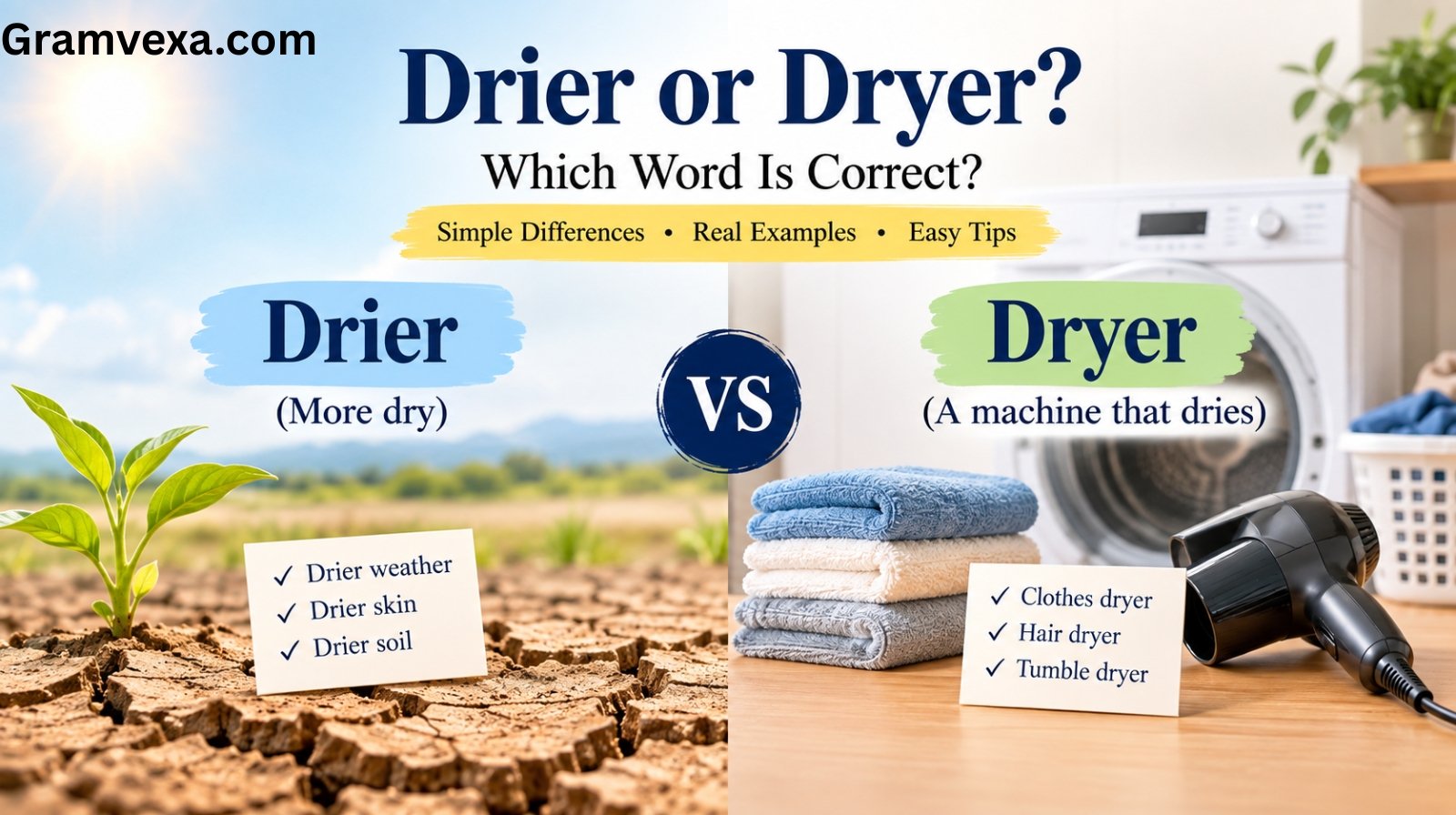
- Drier = usually means more dry.
- Dryer = usually means a machine or device that dries something.
What Does “Drier” Mean?
Drier is most commonly the comparative form of the adjective dry.
It means that something has less moisture than something else.
For example:
- Today is drier than yesterday.
- My skin feels drier in winter.
- This towel is drier than that one.
- The desert climate is drier than the coastal climate.
Cambridge Dictionary lists drier as the comparative form of dry.
Think of it like this:
dry → drier → driest
Just as we say:
cold → colder → coldest
we say:
dry → drier → driest
What Does “Dryer” Mean?
Dryer is commonly used as a noun for a machine or device that removes moisture.
Examples include:
- clothes dryer
- hair dryer
- tumble dryer
- grain dryer
For example:
I put my wet clothes in the dryer.
She used a hair dryer to dry her hair.
Cambridge defines dryer as a machine that dries things and gives examples such as a hair dryer and clothes dryer.
However, there is an important detail: drier can also be used as a noun meaning dryer. So “drier” is not automatically wrong when referring to a machine.
Drier or Dryer: Which One Should You Use?
The answer depends on the meaning you want.
Use “Drier” for Comparisons
Use drier when you mean more dry or are comparing the dryness of two things.
Examples:
This towel is drier than the other one.
The weather is drier this week.
My hair becomes drier during winter.
The soil here is drier than the soil near the river.
A useful test is to replace drier with more dry.
If the sentence still makes sense, drier is probably the right choice.
For example:
The air is drier today.
You could say:
The air is more dry today.
Although “drier” sounds much more natural, the meaning is clear.
Use “Dryer” for a Machine or Device
Use dryer when you are talking about something designed to remove moisture.
Examples:
The dryer stopped working.
I need to buy a new clothes dryer.
She left the towels in the dryer.
My hair dryer is in the bathroom.
In everyday American English, dryer is especially common for appliances such as clothes dryers and hair dryers. Cambridge also recognizes drier as an alternative noun spelling, so the context matters.
A Quick Comparison
| Word | Main Meaning | Example |
|---|---|---|
| Drier | More dry | The air is drier today. |
| Dryer | A machine that dries | Put the clothes in the dryer. |
| Drier | Alternative noun spelling | The drier is broken. |
| Driest | Most dry | This is the driest season. |
Why Do People Confuse Drier and Dryer?
The confusion happens because the two words are pronounced almost identically and both are connected to the word dry.
They Come From the Same Base Word
Both words are related to dry.
The problem begins when the ending -er is added.
For the adjective:
dry → drier
For the noun:
dry → dryer
That small spelling difference changes the usual grammatical role of the word.
Pronunciation Makes the Difference Harder
When spoken aloud, drier and dryer can sound extremely similar.
That means you cannot always rely on pronunciation to determine which spelling is correct.
Instead, look at the meaning and grammatical role.
Ask yourself:
“Am I comparing dryness?”
If yes, drier is usually correct.
Ask:
“Am I talking about a machine?”
If yes, dryer is usually the safest choice.
The Same Problem Appears in Everyday Writing
People often write these words while talking about weather, clothes, hair, skin, or household appliances.
For example:
Comparison:
My skin is drier than usual.
Machine:
I need to clean the dryer.
Both sentences are correct, but the words have different jobs.
Drier vs. Dryer: Examples You Can Remember
Seeing the words in real sentences makes the distinction much easier.
Examples of “Drier”
Here are several examples where drier means “more dry”:
- The weather is drier this month.
- This towel is drier than mine.
- My skin feels drier in cold weather.
- The soil becomes drier during summer.
- The northern region has a drier climate.
- His hair looks drier after swimming.
- The air becomes drier when the temperature changes.
- This part of the garden is drier than the rest.
Examples of “Dryer”
Here are examples where dryer refers to a machine:
- The clothes are still in the dryer.
- Our dryer stopped working yesterday.
- She bought a new hair dryer.
- Please put the towels in the dryer.
- The dryer makes a strange noise.
- I forgot to turn off the dryer.
- The clothes came out of the dryer warm.
- We need to repair the dryer.
Drier and Dryer in the Same Sentence
Sometimes you can use both words together:
The clothes are drier after spending ten minutes in the dryer.
Here:
- drier = more dry
- dryer = the machine
This is one of the easiest sentences to remember the difference.
A Real-Life Example: Choosing Drier or Dryer
Imagine that Sarah has just washed a load of clothes. She takes one towel out of the washing machine and notices that it is still very wet. She puts the towel into the clothes dryer.
After several minutes, Sarah checks the towel again. It is much less wet than before, so she says:
“This towel is drier now.”
Notice what happened.
The first use is dryer because Sarah is talking about the appliance that removes moisture. The second is drier because she is comparing the towel’s current condition with its previous condition.
Later, Sarah notices that one towel is still wetter than another. She says:
“This blue towel is drier than the white one.”
Again, drier is correct because she is making a comparison.
This simple everyday situation shows why the two words can be confusing. The pronunciation is similar, and both words are connected to the process of removing moisture. However, their roles are different. Dryer identifies the thing doing the drying, while drier describes something that has become more dry.
The same distinction works beyond clothes. You can talk about drier weather, drier soil, or drier skin, while a hair dryer or clothes dryer is a device. Once you focus on the meaning rather than just the spelling, choosing between the two becomes much easier.
Drier or Dryer: A Simple Memory Trick
If you keep forgetting the difference between drier and dryer, use this quick rule.
Remember “Drier = More Dry”
When you are comparing two things, think:
Drier = more dry
Examples:
Today is drier than yesterday.
This towel is drier than that one.
The air feels drier today.
Remember “Dryer = Device”
When you are talking about a machine, think:
Dryer = device
Examples:
The clothes are in the dryer.
My hair dryer is broken.
The dryer takes about 40 minutes.
This is not an absolute spelling rule because dictionaries recognize drier as a noun variant of dryer. But as a practical writing tip, it is an excellent way to choose the more familiar form in most everyday situations. (Cambridge Dictionary)
What Recent Data Says About Spelling and Word Confusion
Confusing similar words is a genuine challenge for English learners and writers. Cambridge’s current grammar resources specifically organize common learner problems into areas such as spelling, word choice, and easily confused words, based on real learner errors collected in the Cambridge Learner Corpus.
A 2025 study examining English writing errors among EFL students provides another useful snapshot. In a sample of 27 texts, researchers identified 288 writing errors across correctness, clarity, engagement, and delivery. Of these, 20 were classified as spelling-related correctness errors, including 13 confused-word errors and 7 misspelled-word errors.
Research also shows why automated writing feedback needs to be treated carefully. A study examining Grammarly’s identification of writing issues found 312 spelling/word issues, but only 9 (2.9%) were classified as actual errors in that particular dataset; many flagged items were optional usages or false positives.
The takeaway is simple: don’t rely only on a spell-checker when two words have different meanings. Understanding the context is more reliable.
Drier vs. Dryer: Quick Checklist
Use this checklist whenever you are unsure.
Step 1: Look at the Meaning
Are you describing something as more dry?
- Yes → drier
Are you naming a machine or device?
- Yes → dryer
Step 2: Test the Sentence
Try replacing drier with more dry.
The climate is drier here.
→ The climate is more dry here.
The meaning works, so drier is appropriate.
Now try:
Put the clothes in the dryer.
You cannot naturally replace dryer with more dry.
That tells you dryer is being used as a noun for the appliance.
Step 3: Check the Context
| If you are talking about… | Usually use |
|---|---|
| More dry | Drier |
| Weather comparison | Drier |
| Skin or hair becoming more dry | Drier |
| A clothes machine | Dryer |
| A hair machine | Dryer |
| A device that removes moisture | Dryer |
Mini Quiz: Drier Or Dryer
1. Quick Choice: Which One Fits?
Choose the correct word:
The weather is getting ___ as summer continues.
A) Dryer
B) Drier
Answer: B) Drier ✅
Because drier means “more dry.”
2. Fill in the Blank
I put my wet clothes in the □□□□.
Answer: Dryer ✅
A dryer is a machine used to remove moisture from clothes.
3. Spot the Right Word
Which sentence is correct?
A) My skin feels dryer in winter.
B) My skin feels drier in winter.
Answer: B) My skin feels drier in winter. ✅
Here, drier means “more dry.”
4. Fill It Right!
She used a hair □□□□ before going out.
Answer: Dryer ✅
A hair dryer is a device used to dry hair.
5. Can You Catch the Difference?
Complete the sentence:
This towel is ___ than the one on the chair.
A) dryer
B) drier
Answer: B) drier ✅
The sentence compares the dryness of two towels, so drier is correct.
6. Machine or Comparison?
What does dryer usually refer to?
A) Something that is more dry
B) A machine that dries something
C) The driest object
D) A type of weather
Answer: B) A machine that dries something ✅
7. Fill in the Blank
The air feels □□□□ today than it did yesterday.
Answer: Drier ✅
Because the sentence compares today’s air with yesterday’s air.
8. Which Sentence Sounds Right?
A) Please put the clothes in the drier.
B) Please put the clothes in the dryer.
Answer: B) Please put the clothes in the dryer. ✅
Dryer is the more familiar spelling for the appliance. Drier can also be found as a noun variant in dictionaries.
9. Tiny Grammar Challenge
Complete the pattern:
Dry → □□□□ → driest
A) Dryer
B) Drier
C) Drying
D) Dried
Answer: B) Drier ✅
The comparative form of dry is drier, while driest is the superlative.
10. Final Brain Check 🧠
Which sentence uses both words correctly?
A) The clothes are drier after using the dryer.
B) The clothes are dryer after using the drier.
C) The clothes are drier after using the drier only.
D) The clothes are dryer after using the dryer.
Answer: A) The clothes are drier after using the dryer. ✅
Frequently Asked Questions
Is “drier” or “dryer” correct?
Both can be correct, but they usually have different uses. Drier is normally the comparative form of dry, meaning “more dry,” while dryer commonly refers to a machine that dries something.
Is it “hair drier” or “hair dryer”?
Hair dryer is the more familiar spelling in everyday English, although dictionaries also recognize hair drier as a variant.
Is “clothes drier” correct?
Yes. Clothes drier is a recognized variant spelling of clothes dryer. However, clothes dryer is the more familiar form for many readers, particularly in American English.
Is “drier” the comparative form of “dry”?
Yes. Drier is the standard comparative form of the adjective dry.
For example:
Today is drier than yesterday.
Is “dryer” a verb?
No. Dryer is generally used as a noun when it refers to a machine or device. The verb is dry.
For example:
Please dry the clothes.
Put them in the dryer.
Which is more common: “drier” or “dryer”?
It depends on how the word is being used. Drier is the normal comparative spelling of dry, while dryer is the commonly used spelling for an appliance or drying device. Dictionaries also recognize drier as a noun variant.
Conclusion
So, drier or dryer—which word is correct?
The answer depends on what you mean.
Use drier when you mean “more dry”:
The weather is drier today.
Use dryer when you mean a machine or device that dries something:
The clothes are in the dryer.
The easiest trick is to remember:
Drier = more dry.
Dryer = a drying device.
There is one important exception: drier is also an accepted spelling for the noun dryer, so you may see both forms in dictionaries and real-world writing.
When in doubt, focus on the meaning and context, not just how the word sounds.
Want to avoid more confusing English words? Explore Gramvexa for simple explanations of grammar, spelling mistakes, and commonly confused words.
Keep learning with more easy grammar lessons on Gramvexa.
Authoritative References

Hi, I’m Bilal Khalid, the author of Gramvexa, where I make English grammar simple and easy to understand. I write about grammar, spelling mistakes, confusing words, vocabulary, and common English errors. My goal is to help students, writers, and everyday learners write better and communicate with confidence.