Have you ever typed “tommorow” and then stopped to wonder whether it is actually correct? You are not alone. The confusion usually comes from the middle of the word, where the m and r sounds can make the spelling surprisingly easy to mix up.
The answer is simple: tomorrow is the correct spelling, while tommorow is incorrect.
The correct spelling is:
T-O-M-O-R-R-O-W
That means one M and two R’s. Cambridge Dictionary defines tomorrow as the day after today and also uses it to refer to the future in some contexts.
In this guide, you’ll learn why tomorrow is correct, why tommorow is such a common spelling mistake, how to remember the spelling, and how to use the word naturally in everyday, academic, and professional English.
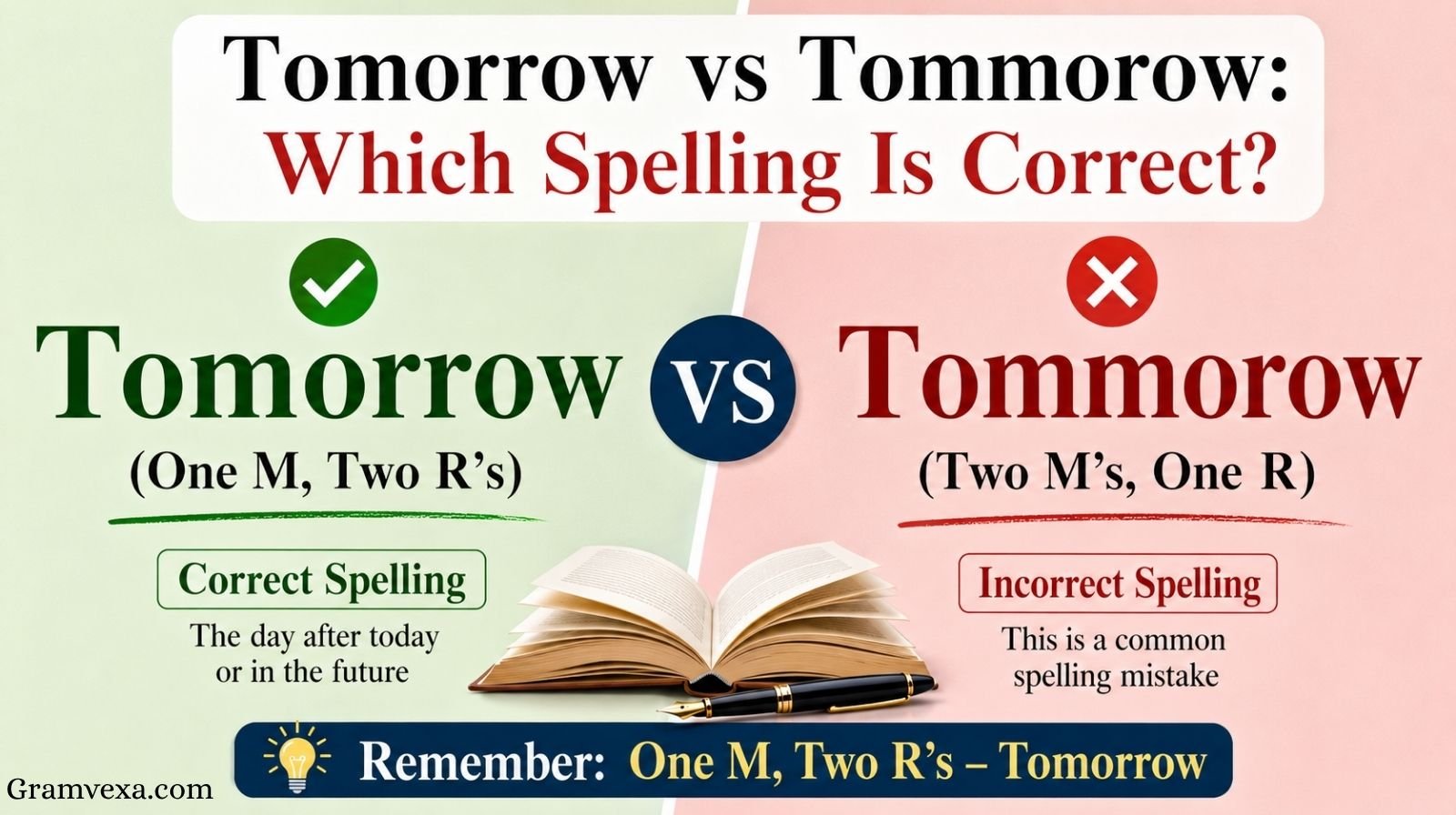
Tomorrow vs Tommorow: Which Spelling Is Correct?
The correct spelling is tomorrow.
Tommorow is a misspelling and should not be used in standard English.
The correct spelling: tomorrow
The word is spelled:
tomorrow
It contains:
- 1 M
- 2 R’s
- 8 letters total
For example:
I will call you tomorrow.
Our meeting is tomorrow morning.
I have to finish this assignment by tomorrow.
The incorrect spelling: tommorow
This version contains an extra M and only one R in the important middle section:
❌ tommorow
For example:
❌ I will send the report tommorow.
The corrected version is:
✅ I will send the report tomorrow.
There is no special situation in which tommorow becomes an acceptable alternative spelling. It is simply a spelling error.
A quick comparison
| Spelling | Correct? | Letter pattern | Meaning |
|---|---|---|---|
| tomorrow | ✅ Yes | 1 M, 2 R’s | The day after today |
| tommorow | ❌ No | 2 M’s, 1 R | Misspelling |
| tomorow | ❌ No | 1 M, 1 R | Misspelling |
| tommorrow | ❌ No | Extra M | Misspelling |
| tomarrow | ❌ No | Incorrect vowel pattern | Misspelling |
What Does Tomorrow Mean?
Tomorrow primarily refers to the day immediately following today. It can function as both a noun and an adverb.
Cambridge Dictionary gives tomorrow as meaning “the day after today” and also notes its broader use for a future time.
Tomorrow as a time expression
You can use tomorrow to talk about something that will happen on the next day.
Examples:
I have an exam tomorrow.
She is leaving tomorrow.
We will discuss the project tomorrow.
If today is Monday, tomorrow is Tuesday.
If today is August 31, tomorrow is September 1.
Tomorrow can also refer to the future
The word can sometimes have a broader meaning.
For example:
We are building a better tomorrow.
Here, tomorrow does not necessarily mean the literal next calendar day. Instead, it refers to the future.
This use is common in phrases such as:
- a better tomorrow
- the leaders of tomorrow
- the technology of tomorrow
- tomorrow’s world
Common expressions with tomorrow
Some useful phrases include:
- tomorrow morning
- tomorrow afternoon
- tomorrow evening
- tomorrow night
- by tomorrow
- until tomorrow
- see you tomorrow
- tomorrow’s meeting
For example:
Please send me the document by tomorrow.
I’ll see you tomorrow morning.
Tomorrow’s meeting starts at 10 a.m.
Why Do People Spell Tomorrow as “Tommorow”?
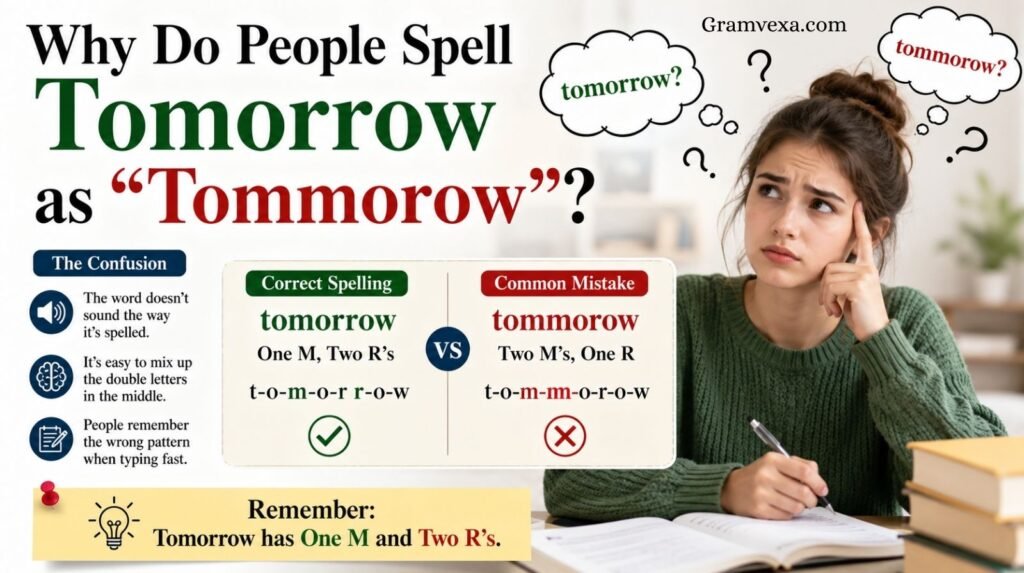
The mistake is understandable because tomorrow is not spelled exactly the way it sounds.
When people hear the word quickly, they may remember the consonants incorrectly and accidentally put the double letter in the wrong place.
The double-letter confusion
The biggest problem is remembering whether the word contains mm or rr.
Compare them:
❌ to-mmo-row
versus:
✅ to-mo-rrow
The correct spelling has the double R, not the double M.
The word “morrow” can help
One useful way to remember the spelling is to recognize the older word morrow.
Morrow is a literary word meaning the next day or tomorrow.
So you can mentally break tomorrow into:
to + morrow
Notice that morrow has the double r:
morrow
Therefore:
to + morrow = tomorrow
You do not need to use morrow in everyday conversation, but it is a useful spelling clue.
The easiest memory trick
Remember this sentence:
Tomorrow has one M and two R’s.
Or simply memorize:
One M → Two R’s → tomorrow
If you’re unsure while writing, look at the middle:
to-mo-rrow
The RR belongs in tomorrow.
How to Use Tomorrow Correctly
Knowing the spelling is only half the job. You also need to know how to use tomorrow naturally in a sentence.
Everyday examples
Here are some common examples:
Are you free tomorrow?
I’ll call you tomorrow.
We are going shopping tomorrow.
My brother arrives tomorrow.
Let’s talk about it tomorrow.
These sentences are natural in both casual and standard English.
Professional examples
Tomorrow is also completely appropriate in professional writing.
For example:
I will send the revised document tomorrow.
The team meeting has been scheduled for tomorrow morning.
Please complete the report by tomorrow afternoon.
Notice that the spelling does not change according to the level of formality.
Academic examples
Students can use tomorrow in essays, assignments, emails, and other school-related writing when the context requires it.
For example:
The final examination will take place tomorrow.
Students must submit their projects by tomorrow.
The research team will continue the experiment tomorrow.
Whether you are writing a text message or a formal assignment, the correct spelling remains tomorrow.
Real-Life Example: How a Small Spelling Error Can Matter
Imagine a university student named Sarah preparing an important email to her professor. She writes:
“I will submit my assignment tommorow morning.”
The professor will almost certainly understand what Sarah means. The incorrect spelling does not make the sentence impossible to understand. However, the error is still noticeable because tomorrow is a familiar everyday word.
Sarah checks the sentence before sending it and notices the problem. She changes it to:
“I will submit my assignment tomorrow morning.”
That small correction makes the sentence look polished and professional.
The same situation can happen in workplace communication. Imagine an employee writing to a client:
“We will send the final proposal tommorow.”
Again, the meaning is obvious, but the spelling mistake can make the message look less carefully prepared. Correcting it to:
“We will send the final proposal tomorrow.”
removes the distraction completely.
This is why knowing the difference between tomorrow and tommorow matters. The mistake usually does not prevent understanding, but avoiding simple spelling errors helps your writing look more accurate and professional.
The lesson is straightforward: when writing quickly, especially in emails, applications, schoolwork, or business communication, remember the pattern one M and two R’s.
Tomorrow Spelling: What Current Sources Tell Us
There is no credible 2025–2026 linguistic dataset showing that tommorow has become an accepted alternative spelling. Current dictionary evidence continues to recognize tomorrow as the standard English word. Cambridge Dictionary lists tomorrow as the accepted spelling and defines its primary meaning as the day after today.
A useful 2025–2026 data point
A current search of English-language spelling resources in 2026 continues to show the same distinction: tomorrow is treated as the correct form, while tommorow is described as a misspelling. Recent 2026 spelling references specifically address the one-M/two-R pattern.
It is important not to confuse search interest with language correctness. Search volumes can change by country, device, season, and user behavior, while dictionary spelling is based on established English usage.
Google’s current Search guidance also emphasizes helpful, accurate, well-written content and recommends avoiding factual or spelling errors.
What the evidence means
The practical takeaway is clear:
2026 standard English:
✅ tomorrow
2026 standard English:
❌ tommorow
There is no need to choose between them based on American versus British English. The standard spelling is tomorrow.
A Simple Guide to Never Misspell Tomorrow Again
If you regularly make this mistake, use this three-step method.
Step 1: Start with “to”
Write:
to
Step 2: Add “morrow”
Remember:
morrow
It contains two R’s.
Step 3: Put them together
to + morrow = tomorrow
Now check the middle:
t o m o r r o w
That’s:
1 M + 2 R’s
Quick checklist
Before submitting an important piece of writing, check:
- Did I write tomorrow?
- Does it have only one M?
- Does it have two R’s?
- Did I accidentally write tommorow?
- Did I accidentally write tomorow?
If the answer is one M + two R’s, you’re good.
Mini Quiz: Tomorrow vs Tommorow
1. Which spelling is correct?
A) Tommorow
B) Tomorrow
C) Tomorow
D) Tomarrow
Answer: B) Tomorrow
2. Fill in the blank
The correct spelling is T□□□□□□□.
Answer: Tomorrow
3. How many M’s are in “tomorrow”?
A) One
B) Two
C) Three
D) None
Answer: A) One
4. How many R’s are in “tomorrow”?
A) One
B) Two
C) Three
D) Four
Answer: B) Two
5. Pick the correctly spelled sentence.
A) I will call you tommorow.
B) I will call you tomorow.
C) I will call you tomorrow.
D) I will call you tomarrow.
Answer: C) I will call you tomorrow.
6. Fill in the blank
Tomorrow = One M + Two □’s
Answer: R’s
7. What does “tomorrow” usually mean?
A) The day before today
B) The same day
C) The day after today
D) Last week
Answer: C) The day after today
8. Which word is a common misspelling of “tomorrow”?
A) Tomorrow
B) Tommorow
C) Morrow
D) Today
Answer: B) Tommorow
9. Fill in the blank
The correct word is: to + morrow = □□□□□□□□
Answer: Tomorrow
10. Which sentence uses “tomorrow” correctly?
A) Tomorrow I went to school yesterday.
B) I have an exam tomorrow.
C) Tomorrow means last night.
D) I finished it tomorrow.
Answer: B) I have an exam tomorrow.
11. Quick spelling check: Which one has one M and two R’s?
A) Tommorow
B) Tomorow
C) Tomorrow
D) Tomarrow
Answer: C) Tomorrow
12. Fill in the blank
Please send me the report by □□□□□□□.
Answer: tomorrow
13. True spelling challenge: Which version should you use in a professional email?
A) Tommorow
B) Tomorow
C) Tomarrow
D) Tomorrow
Answer: D) Tomorrow
14. Final Memory Test: Complete the rule
Tomorrow = 1 M + 2 R’s + □□□□
A) Today
B) The future
C) One W
D) Two M’s
Answer: B) The future
Quick memory trick: 🧠 TO + MORROW = TOMORROW → One M, Two R’s.
FAQs
Is “tommorow” correct?
No. Tommorow is an incorrect spelling. The correct spelling is tomorrow, with one M and two R’s.
How do you spell tomorrow correctly?
Spell it:
T-O-M-O-R-R-O-W
A useful memory trick is one M, two R’s.
Is it “tomorrow” or “tommorow”?
It is tomorrow.
✅ Tomorrow
❌ Tommorow
Why is tomorrow spelled with two R’s?
The spelling is connected to the older word morrow, which refers to the next day. Since morrow contains rr, the modern word tomorrow retains that double-R pattern.
Is “tommorow” a different word?
No. Tommorow is not a separate English word with a different meaning. It is simply a misspelling of tomorrow.
How many M’s are in tomorrow?
There is one M in tomorrow.
t-o-m-o-r-r-o-w
How many R’s are in tomorrow?
There are two R’s:
t-o-m-o-r-r-o-w
Is “tomorrow” used in American and British English?
Yes. Tomorrow is the standard spelling in both American and British English. The pronunciation can vary slightly by accent, but the spelling remains the same.
Conclusion
When choosing between tomorrow vs tommorow, there is only one correct choice: tomorrow.
Remember the simple rule:
Tomorrow = one M + two R’s
The incorrect form tommorow may be understandable, but it is still a spelling mistake. Whether you’re writing a text, school assignment, professional email, application, or article, use tomorrow.
The easiest way to remember it is to break the word into:
to + morrow = tomorrow
Once you remember that morrow contains the double R, the spelling becomes much easier.
So next time you hesitate, don’t second-guess yourself:
Tomorrow is correct. Tommorow is not.
For more practical English spelling and word-choice guides, bookmark this page and check back whenever a commonly confused word makes you pause.
Keep learning with more easy grammar lessons on Gramvexa
Authoritative References

Hi, I’m Bilal Khalid, the author of Gramvexa, where I make English grammar simple and easy to understand. I write about grammar, spelling mistakes, confusing words, vocabulary, and common English errors. My goal is to help students, writers, and everyday learners write better and communicate with confidence.