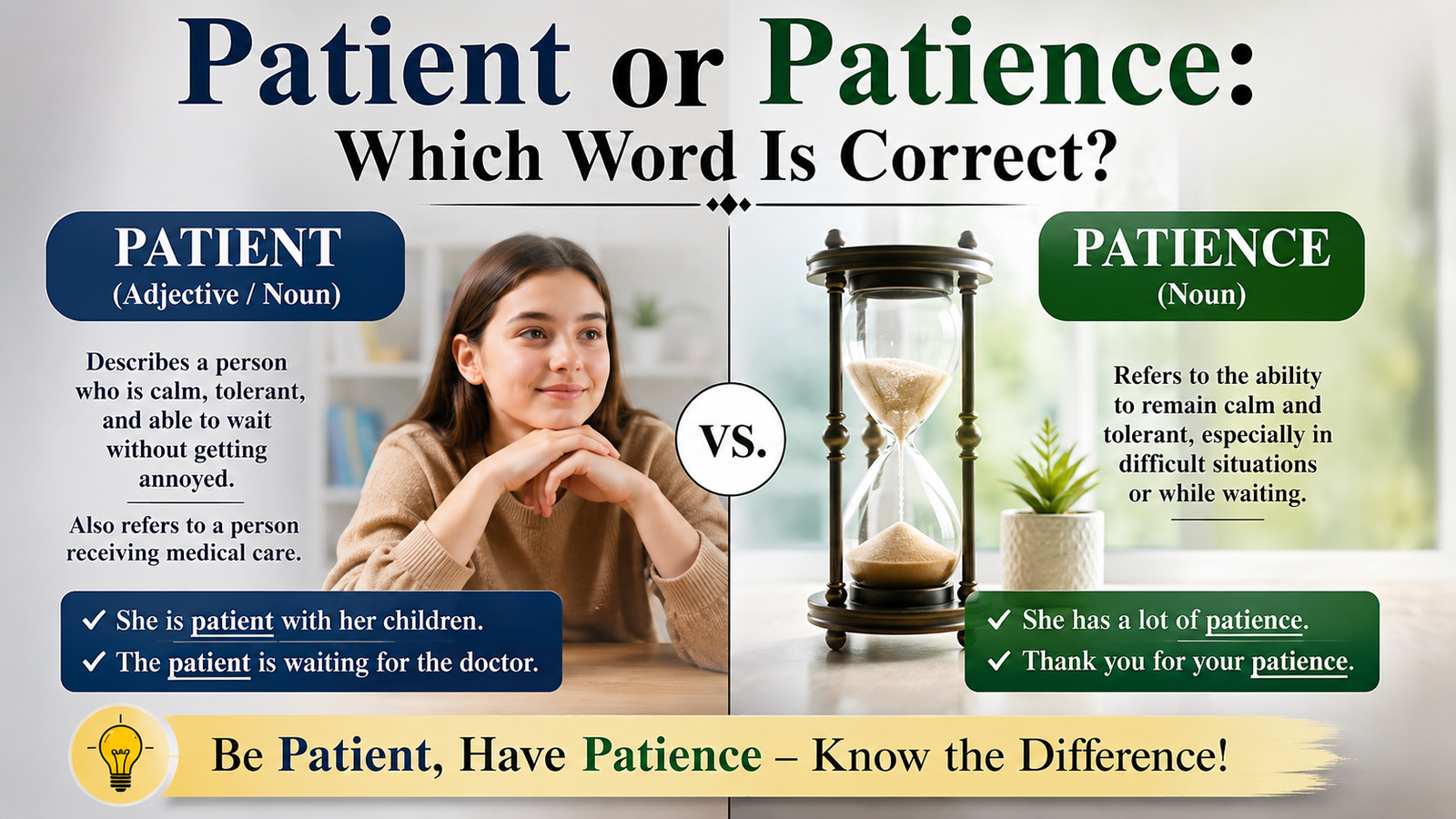
If you have ever wondered whether to write patient or patience, you are not alone. These two words look and sound closely related, but they do different jobs in a sentence. Patient can describe someone who stays calm or refer to a person receiving medical treatment, while patience is the ability to remain calm while waiting or dealing with difficulties.
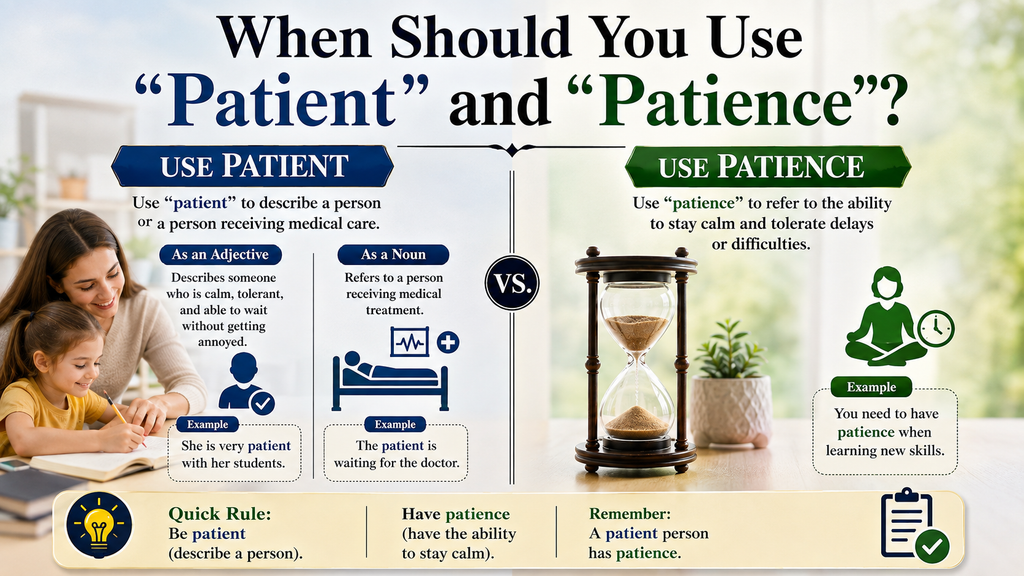
The easiest rule is simple: use patient to describe someone, and use patience to name the quality of staying calm.
For example:
- She is patient with her students. ✅
- She has a lot of patience with her students. ✅
- She is patience with her students. ❌
- She has a lot of patient. ❌
Let’s look at the difference in detail so you can choose the right word every time.
Patient or Patience: What Is the Difference?
Although patient and patience are closely related, they are not interchangeable. The main difference is their grammatical role.
Patient is usually an adjective when it describes someone’s behavior. It can also be a noun when it means someone receiving medical care.
Patience is a noun that refers to the ability to wait, tolerate problems, or remain calm without becoming annoyed.
Cambridge Dictionary defines patience as the ability to wait or continue despite difficulties without becoming annoyed, while patient can describe someone who is able to wait calmly.
Patient Meaning and Usage
When patient is an adjective, it describes someone who does not become easily annoyed or frustrated.
Examples:
- My teacher is very patient.
- Please be patient while I check your account.
- He remained patient during the long meeting.
- Parents need to be patient with young children.
In each example, patient describes a person or their behavior.
However, patient has another meaning as a noun:
- The patient is waiting in the examination room.
- The doctor examined the patient.
- The hospital admitted three new patients.
Here, patient has nothing to do with being calm. It means a person receiving medical care.
Patience Meaning and Usage
Patience is a noun. It describes the quality or ability to remain calm when something takes time or becomes difficult.
Examples:
- Learning a new language requires patience.
- Thank you for your patience.
- She has a lot of patience with children.
- I am starting to lose my patience.
Merriam-Webster similarly defines patience as the ability to accept delays or difficulties calmly and to persevere despite challenges.
Patient vs. Patience at a Glance
| Word | Part of Speech | Main Meaning | Example |
|---|---|---|---|
| Patient | Adjective | Calm and tolerant | She is patient. |
| Patient | Noun | Person receiving medical care | The patient is resting. |
| Patience | Noun | Ability to remain calm | He has patience. |
A useful way to remember the relationship is:
A patient person has patience.
When Should You Use “Patient”?
Use patient when you are describing a person who can wait calmly, tolerate difficulties, or avoid becoming frustrated.
“Be Patient” Is Correct
One of the most common expressions is be patient.
Examples:
- Please be patient; your order will arrive soon.
- Be patient with yourself while learning English.
- You need to be patient during the recovery process.
Why is patient correct here? Because it is an adjective describing someone’s behavior or state.
You would not normally write:
- ❌ Please be patience.
- ❌ You need to be patience.
Instead, write:
- ✅ Please be patient.
- ✅ You need to be patient.
Patient as a Medical Noun
Remember that patient can also be a noun in medical contexts.
Examples:
- The patient needs additional tests.
- The nurse spoke with the patient.
- The doctor treated several patients today.
The plural form is patients.
This is especially important because patients and patience can sound very similar in everyday speech, even though their meanings and spellings are different.
Patient in Everyday Sentences
Here are some natural examples:
- My father is very patient with children.
- She remained patient despite the delay.
- Try to be patient when learning something difficult.
- The patient was discharged from the hospital.
The context tells you which meaning of patient is intended.
When Should You Use “Patience”?
Use patience when you are talking about the quality or ability to remain calm.
“Have Patience” Is Correct
A very useful expression is have patience.
Examples:
- You need to have patience when teaching beginners.
- She has remarkable patience.
- I don’t have much patience for unnecessary arguments.
You can also use common expressions such as:
- lose your patience
- run out of patience
- test someone’s patience
- show patience
- practice patience
- require patience
For example:
The long delay tested everyone’s patience.
“Thank You for Your Patience”
You will often see “Thank you for your patience” in emails, websites, customer-service messages, and announcements.
For example:
Thank you for your patience while we work to resolve the issue.
This is correct because patience is the noun referring to the quality of remaining calm during a delay.
Do not write:
❌ Thank you for your patient.
That changes the meaning and grammatical structure.
Patience in Real-Life Situations
Patience is useful when talking about situations that require time, tolerance, or persistence.
Examples:
- Learning to play the piano takes patience.
- Raising children requires patience.
- You need patience when dealing with difficult customers.
- Building a successful business takes time and patience.
Patient vs. Patience: Easy Grammar Rules
If you still find patient or patience confusing, focus on the structure of the sentence rather than trying to memorize every example.
Use “Patient” After “Be”
A simple pattern is:
be + patient
Examples:
- Be patient.
- She is patient.
- They were patient.
- He remained patient.
Because patient is an adjective, it works naturally after linking verbs such as be, remain, and stay.
Use “Patience” After “Have”
Another useful pattern is:
have + patience
Examples:
- I have patience.
- She has patience.
- We need patience.
- They showed patience.
You can also say:
I don’t have the patience to wait any longer.
The noun patience names the quality itself.
A Simple Comparison
| If you want to say… | Use | Example |
|---|---|---|
| Someone is calm | patient | She is patient. |
| Someone should wait calmly | patient | Please be patient. |
| Someone possesses calm endurance | patience | She has patience. |
| A quality is required | patience | This requires patience. |
| Someone receives medical treatment | patient | The patient is resting. |
| More than one person receives treatment | patients | The doctor treated five patients. |
Common Mistakes With Patient and Patience
The confusion usually happens because the words share similar letters and meanings. However, a few simple corrections can make the distinction much easier.
“Be Patient” vs. “Be Patience”
Correct:
- Please be patient.
- You should be patient with beginners.
- He needs to be patient.
Incorrect:
- ❌ Please be patience.
- ❌ You should be patience.
- ❌ He needs to be patience.
The reason is simple: after be, you need the adjective patient when describing someone’s behavior.
“Have Patience” vs. “Have Patient”
Correct:
- Please have patience.
- She has patience with her students.
- I don’t have much patience today.
Incorrect:
- ❌ Please have patient.
- ❌ She has patient with her students.
- ❌ I don’t have much patient.
Here, the sentence needs the noun patience.
“Thank You for Your Patience”
This is another common spelling and grammar mistake.
Correct:
Thank you for your patience.
Incorrect:
❌ Thank you for your patient.
The word patience refers to the quality you are thanking someone for showing.
Patient, Patients, and Patience: Don’t Mix Them Up
There are actually three forms worth remembering:
- Patient = calm and tolerant, or one person receiving medical care
- Patients = two or more people receiving medical care
- Patience = the ability to remain calm
Patient
The teacher is patient with her students.
Here, patient is an adjective.
Patients
The doctor examined six patients.
Here, patients is the plural noun for people receiving medical care.
Patience
The teacher has great patience.
Here, patience is the noun describing the quality.
A helpful memory trick is:
Patients → people
Patience → calmness
If you are talking about people in a hospital or clinic, think patients. If you are talking about staying calm, think patience.
A Real-Life Example: Choosing the Right Word
Imagine that Sarah works as an elementary-school teacher. One afternoon, she has a classroom full of students who are learning a difficult math concept. Several students keep asking the same question, while others become frustrated because they cannot solve the problem.
Sarah does not become angry. Instead, she explains the concept again, gives another example, and encourages the students to keep trying.
You could say:
“Sarah is very patient with her students.”
Here, patient describes Sarah’s behavior.
You could also say:
“Sarah has a lot of patience with her students.”
In this sentence, patience names the quality that allows Sarah to remain calm.
Later that afternoon, Sarah visits a doctor because she has been feeling unwell. In the clinic, she becomes a patient.
Now the word has a completely different meaning:
“Sarah is a patient at the clinic.”
This example shows why context matters. The same word patient can describe someone’s calm behavior or refer to someone receiving medical care. Meanwhile, patience always refers to the quality of remaining calm, waiting, or enduring difficulty.
Once you identify whether you are describing a person, naming a quality, or talking about medical care, choosing the correct word becomes much easier.
What Recent Data Says About English Writing
Correct word choice matters because English is used by an enormous global audience, including native speakers and people learning English as an additional language.
The British Council currently estimates that nearly one-third of the world’s population speaks English, and it reports that English is an official language in 67 nations.
The 2025 Duolingo Language Report also found that English was the most studied language in 154 countries, representing 79% of the countries covered by its global language-learning data.
Writing accuracy remains a real challenge for learners. A 2025 study of English writing among university students in Indonesia identified 78 grammatical and mechanical errors, with capitalization, verbs, and nouns among the most frequent categories.
These figures do not show that patient and patience are among the most frequently confused words specifically. Rather, they demonstrate the broader importance of accurate English word choice as more people learn and use English internationally.
A Quick Step-by-Step Method to Choose the Right Word
When you’re unsure whether to use patient or patience, use this three-step check.
Step 1: Ask What You Mean
Are you describing someone’s behavior?
Use patient.
She is patient with her children.
Are you naming the quality of staying calm?
Use patience.
She has patience with her children.
Step 2: Look at the Verb
If you see be, stay, remain, or seem, patient may be the correct choice when describing someone.
- Be patient.
- Stay patient.
- She remained patient.
If you see have, need, require, show, or lose, patience is often the correct noun.
- Have patience.
- We need patience.
- The task requires patience.
- He lost his patience.
Step 3: Check for Medical Meaning
If the sentence refers to someone receiving medical care, use patient.
- The patient is waiting for the doctor.
- The hospital treated several patients.
If the sentence is about calmness or tolerance, use patience.
- The nurse showed great patience.
Patient vs. Patience: The Easiest Memory Trick
Try remembering this pair:
Be patient.
Have patience.
These two phrases capture the basic grammatical difference.
Think of it this way:
Patient = the person or behavior you can see.
Patience = the quality behind that behavior.
So:
She is patient because she has patience.
Once you remember that sentence, the difference becomes much easier.
FAQs
Is “patient” or “patience” correct?
Both are correct, but they have different meanings and grammatical roles. Patient can be an adjective meaning calm and tolerant, or a noun meaning someone receiving medical care. Patience is a noun meaning the ability to remain calm while waiting or dealing with difficulties.
Is it “be patient” or “be patience”?
The correct phrase is “be patient.”
For example:
Please be patient while we process your request.
Patient is an adjective here, so “be patience” is incorrect.
Is it “have patience” or “have patient”?
The correct phrase is “have patience.”
For example:
You need to have patience when learning a new skill.
Patience is the noun for the quality of remaining calm.
Is “thank you for your patient” correct?
No. The standard expression is:
“Thank you for your patience.”
Here, patience means the calmness or tolerance someone showed during a delay or difficult situation.
What is the difference between patient and patients?
Patient can mean one person receiving medical care, while patients is its plural form.
For example:
- The patient is waiting.
- The patients are waiting.
Patients does not mean calmness. The word for that quality is patience.
Are “patients” and “patience” pronounced the same?
They are pronounced very similarly and can sound the same or nearly the same in ordinary speech. That is why context and spelling are important when writing them.
What is the easiest way to remember patient and patience?
Remember:
Be patient = describe someone as calm.
Have patience = possess the ability to stay calm.
And for medical situations:
A patient = a person receiving medical care.
Conclusion
So, patient or patience which word is correct? The answer depends on what you mean.
Use patient when describing someone who remains calm, tolerant, or willing to wait:
She is patient with her students.
Use patience when talking about the quality of staying calm or tolerating delays:
She has a lot of patience with her students.
And use patient as a noun when referring to someone receiving medical care:
The patient is waiting for the doctor.
The quickest rule to remember is “be patient” but “have patience.” Once you understand that difference, choosing between patient and patience becomes much easier.
If you often get confused by similar English words, keep exploring clear word-choice guides on Gramvexa to build stronger grammar, spelling, and everyday English skills.
Keep learning with more easy grammar lessons on Gramvexa.
Authoritative References
Cambridge Dictionary — Patience

Hi, I’m Bilal Khalid, the author of Gramvexa, where I make English grammar simple and easy to understand. I write about grammar, spelling mistakes, confusing words, vocabulary, and common English errors. My goal is to help students, writers, and everyday learners write better and communicate with confidence.